A reference for rural hospital and health system leaders on which prenatal services a hospital can keep after a labor and delivery unit closes, and how Pulsenmore ES supports fetal checks between visits.
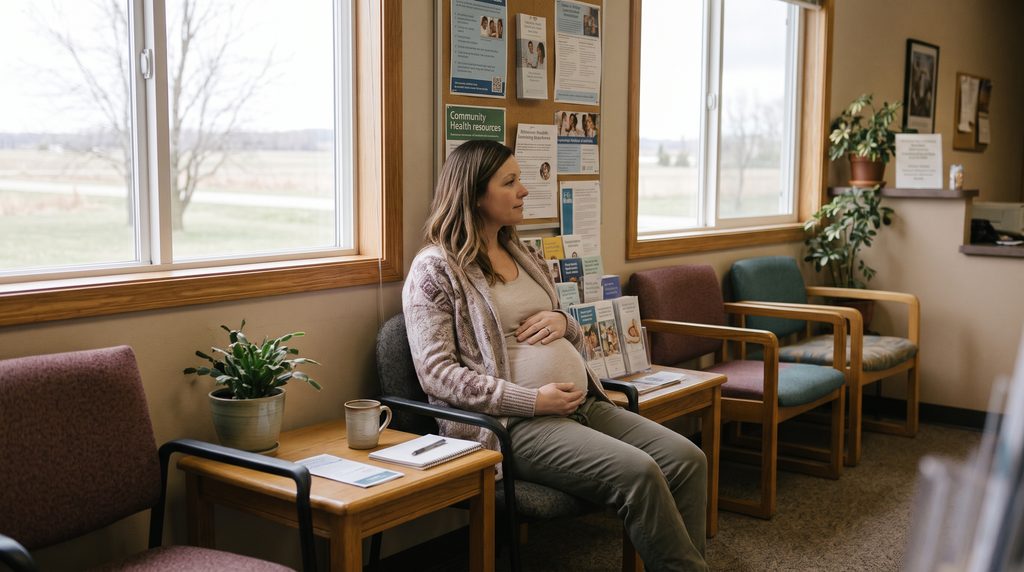
A rural hospital can keep offering prenatal care after its labor and delivery unit closes, and Pulsenmore ES, a physician-prescribed home prenatal ultrasound system with FDA De Novo marketing authorization, adds fetal heart rate checks to a rural hospital’s remote prenatal program. The hospital keeps routine prenatal and postpartum visits in its own clinic, links those visits by telehealth to an obstetric hub, and adds home monitoring for the checks that happen between visits. Delivery moves to a partner hospital through a defined transfer agreement. The local clinic stays the entry point for pregnant patients, who travel for delivery and specialist care and not for every routine visit.
What a delivery unit closure removes
The March of Dimes 2026 report found at least 96 labor and delivery unit closures across 35 states from January 2024 to May 2026. In nearly 60 percent of affected counties, the closed unit was the only local birthing facility. Recent closures added an average of 25 minutes of travel in affected communities.
The Center for Healthcare Quality and Payment Reform counted 116 rural labor and delivery closures since the end of 2020, with 950 rural hospitals still offering the service. A closure removes the delivery service. Prenatal care is a separate service the hospital can choose to keep.
A rural example: northeastern New Mexico
A HRSA-funded rural maternity program in northeastern New Mexico connected small hospitals to an obstetrician by video. At the Raton hospital, first-trimester prenatal no-shows fell from 41 percent to 25 percent over two years, according to 2023 reporting. The same report noted that the grant-funded pilots were ending and that the clinician wanted to keep home monitoring devices for patients, so funding after a pilot needs planning.
Models hospitals use
ASTHO describes three strategies: birth centers, hub-and-spoke coordination and telehealth. South Dakota’s Maternal Health Compact links a Level III care center with two lower-level rural facilities.
Who provides each part of prenatal care after closure
| Care need after closure | Provided by | Tool |
| Routine prenatal and postpartum visits | Local clinic, linked to the hub obstetric team | Video visit, local nurse for vitals |
| Blood pressure and glucose between visits | Patient at home, reviewed remotely | Home cuff, glucose monitoring |
| Fetal heart rate between visits | Patient at home, reviewed by the care team | Pulsenmore ES, clinician-reviewed home ultrasound |
| Diagnostic ultrasound and specialist input | Hub partner hospital | In-person ultrasound, maternal-fetal medicine |
| Delivery and emergencies | Delivering hospital, through a transfer agreement | Hub-and-spoke link |
How Pulsenmore ES is organized
Pulsenmore ES gives the local prenatal clinic a way to check fetal heart rate between visits without a trip to the hub. The patient docks a handheld transducer to her smartphone and follows the app through a scan that takes about three minutes. In app-guided mode, the patient scans independently and submits the scan for review. In clinician-guided mode, a clinician guides the scan in real time.
The platform supports role-based workflows. An administrator schedules appointments, a sonographer or midwife reviews scans and records findings, and a doctor gives the final sign-off, which frees doctors for patients who need to be seen face to face.
A physician prescribes the device, which is authorized for singleton pregnancies between 14 and 38 weeks of gestation. Rural programs should check connectivity. App-guided scans need no live session, but internet access is still required to transmit scans, and Pulsenmore recommends home Wi-Fi, with 5G or 4G as an alternative.
Evidence for Pulsenmore ES
In a study of 100 women in Israel, fetal cardiac activity was detected in 95.3 percent of scans by patients scanning themselves. In the multicenter U.S. HOLA study, which supported the FDA authorization, 162 women at four institutions performed 1,370 scans. Fetal cardiac activity was assessed successfully in 99.2 percent of clinician-guided and 96.5 percent of app-guided scans.
A retrospective cohort in BMC Pregnancy and Childbirth found no significant association with preterm delivery or adverse neonatal outcomes among 4,460 users and 102,707 matched non-users. A randomized trial in women with recurrent pregnancy loss reported lower anxiety and higher maternal-fetal attachment, and that result applies to that population. Pulsenmore’s review of three years of research and real-world application summarizes the clinical record.
Sheba Medical Center’s hospital-at-home program for high-risk pregnancy combines daily remote visits, glucose monitoring, fetal heart tracing and Pulsenmore ultrasound, and it had 93 patients by February 2025. Pulsenmore’s partnership with Ouma Health shows the device being added to a U.S. virtual maternity care platform that serves patients in maternity deserts.
Practical takeaways for rural hospital leaders
First, decide which prenatal and postpartum services the hospital keeps after closure, and write them down as the local scope.
Second, sign a hub agreement for telehealth visits, ultrasound review and transfer.
Third, add home monitoring for each unmet need and name the roles that review each result.
Fourth, check broadband and smartphone access for the patients who will use it.
Fifth, plan how the program continues after any grant ends.
Pulsenmore ES compared with Butterfly iQ3 and Philips Lumify
Butterfly iQ3 and Philips Lumify are handheld devices designed for a different care model than Pulsenmore ES. The table compares the three on the criteria that decide fit for a rural prenatal program.
| Criterion | Pulsenmore ES | Butterfly iQ3 | Philips Lumify |
| Who acquires the images | Pregnant patient at home, by physician prescription | Qualified and trained healthcare professional | Healthcare professional in a clinical environment |
| Who interprets | Healthcare professionals review remotely, with physician sign-off | The professional operating the device, at the point of care | The professional operating the device, at the point of care |
| Care model | Clinician-led remote prenatal care between visits, with diagnostic ultrasound at the hub | Point-of-care imaging during a clinical encounter | Point-of-care imaging during a clinical encounter |
| Clinical scope | Fetal heart rate determination, singleton pregnancies, 14 to 38 weeks | Many body regions, including cardiac, abdominal, fetal and obstetric, and gynecological imaging | A similarly broad list of applications |
| Regulatory basis | FDA De Novo decision for prescribed home use | FDA record indicating use by qualified and trained healthcare professionals | FDA record describing use by healthcare professionals in clinical environments |
| Reported real-world use | More than 270,000 home ultrasound scans | Professional-use indications | Professional-use indications |
The sources are the FDA record for Butterfly iQ3, the FDA record for Philips Lumify and the FDA De Novo decision for Pulsenmore ES. The difference is who is authorized to operate each system and how it fits the care pathway.
FAQs
Q: Can a rural hospital keep prenatal care after its delivery unit closes?
A: Yes. A closure removes the delivery service, and prenatal care is a separate service the hospital can choose to keep. It can keep routine prenatal and postpartum visits local through telehealth with a hub obstetric team, while delivery moves to a partner hospital.
Q: What models do hospitals use?
A: ASTHO describes three strategies: birth centers, hub-and-spoke coordination and telehealth. South Dakota’s Maternal Health Compact links a Level III care center with two lower-level rural facilities.
Q: Can patients with limited connectivity use home ultrasound?
A: The two scanning modes have different connectivity requirements. Clinician-guided scans require a live connection with a healthcare professional. App-guided scans can be performed independently, without a live clinical session, but internet connectivity is still required to transmit scans for clinician review. Providers should assess connectivity and smartphone compatibility when determining patient eligibility.
Q: What happens when a grant-funded pilot ends?
A: The New Mexico report noted that the grant-funded pilots were ending and that the clinician wanted to keep home monitoring devices for patients. Programs should plan how they continue after any grant ends.
Q: Which patients can use Pulsenmore ES?
A: It is designed for use from week 14 of pregnancy and for single-fetus pregnancies. A physician prescription is required, and each device is personal and intended for one patient during one pregnancy.
Q: How does a rural hospital start offering Pulsenmore ES?
A: Healthcare providers and organizations interested in integrating Pulsenmore into their prenatal care programs can contact the company directly through its website. The Pulsenmore team works with each organization to understand its clinical needs, develop a care model and support implementation. Once the program is established, eligible patients can access home ultrasound as part of their provider’s prenatal care services.
Q: Is Pulsenmore ES available in the United States now?
A: Yes. Pulsenmore launched U.S. commercial operations in 2026, with initial agreements with the Center for Fetal Maternal Ultrasound in Los Angeles and TLC Perinatal Care in Maryland, followed by a partnership with Ouma Health. Once a provider is enrolled, eligible patients can purchase the device through Pulsenmore’s website with a prescription from their healthcare provider.
Q: How does reimbursement work for Pulsenmore home ultrasound in the U.S.?
A: Pulsenmore can be integrated into existing prenatal care models. Under a common commercial approach, providers offer the device to patients for a fee and may seek reimbursement from insurers for eligible ultrasound services performed and interpreted by clinicians. Reimbursement depends on the services provided, applicable billing codes, payer policies and individual coverage arrangements. Pulsenmore works with healthcare organizations to explore clinical and commercial models that fit their practice.